Peace Treaty which was signed in Vereeniging, commemorated at Blockhouse
A wreath laying ceremony was held at the Witkop Blockhouse on May 31 to commemorate the history of the site as well as the 115th anniversary of the signing of the Peace Treaty in Vereeniging.

Retha Fitchat
MIDVAAL. – A wreath laying ceremony was attended by the Midvaal Local Municipality, the Speaker’s office and the Blockhouse Stakeholders at the Witkop Blockhouse on May 31 to commemorate the history of the site as well as the 115th anniversary of the signing of the Peace Treaty in Vereeniging. (The actual signing in 1902 took place in a tent in Vereeniging)
In his address at the event, Midvaal Speaker Cllr Freddie Peters emphasised the importance of ensuring the blockhouse is retained to its original form as it forms part of South Africa’s history. “Years from now future generations can learn about the structure and its significance and contribution during the Anglo-Boer War,” said Peters.
The Witkop Blockhouse is situated within a few minutes drive from Henley on Klip on the R59 near the Engen garage. It is one of only fifty blockhouses left in the country. Built during 1901, the Witkop Blockhouse played a vital role for the British war efforts during the Anglo-Boer War between 1899 and 1902.
According to information provided by the Klip River-Suikerboschrand Conservancy the Witkop Blockhouse was proclaimed as a Historical Monument in 1948. The blockhouse, built in 1901, stands as the sole surviving sentinel of what were probably more than 100 Rice Pattern Blockhouses and at least several other stone sentinels erected along the railway line between Wolwehoek and Irene. Major General H.E. Wood designed the standardised stonemasonry blockhouse, which stood two to three storeys high. It was roofed and loop-holed to provide a 360° arc of rifle fire.
Two stone Blockhouses were built at Witkop to replace the garrison and to guard two small stone bridges which both survive beneath the railway tracks to this day. Only one blockhouse remains and it is known as the Witkop Blokhouse. It stands on a hill, one mile North of the original garrison’s position which was also marked by a second blockhouse that was demolished in the 1970’s. These blockhouses were provisioned with water, rations and ammunitions so that its garrison of about 30 infantrymen could withstand a prolonged siege. They were placed so that they could defend bridges, railway lines, water supplies and permanent garrisons. Each blockhouse cost between £800 and £1000 and took military engineers, troops and African Labourers plus-minus six weeks to erect.
The graves of the African Settlement at Witkop lie to the East of the blockhouses, as do theplus-minus 450 graves of the African inmates at the site of the Taaibosch Concentration Camp.
During their stay the British Army imported fodder from Argentina to feed their cavalry and mounted troop’s horses. The seeds of the cosmos flower travelled inside the feed and today, when the cosmos blooms, it marks many of the sites of this military conflict.
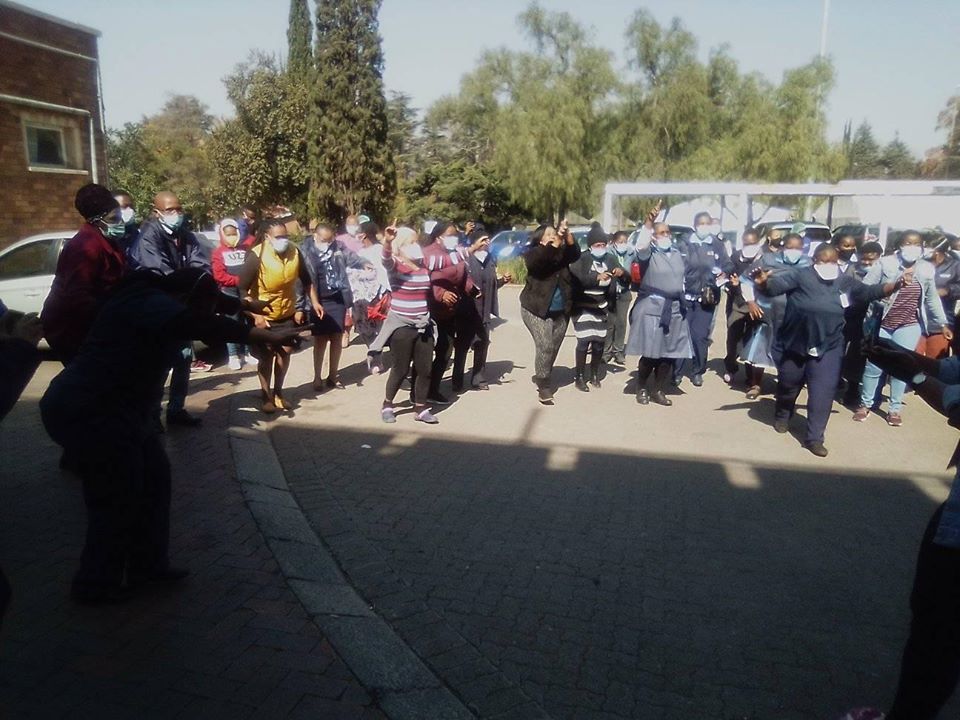
Photo: Members of the Midvaal Local Municipality, the Speaker’s office and members of the Blockhouse Stakeholders at the wreath-laying ceremony on 31 May to commemorate the history of the Witkop Blockhouse and the signing of the peace treaty between the Boers and the English, which ended the Anglo-Boer War.