South Africa’s Most Venomous Snakes
With summer on it’s way, the temperature and humidity are perfect for snakes to come out of their hiding places and scare the living daylights out of unsuspecting humans. There is seldom any reason to kill a snake, as there are many organisations and individuals who dedicate themselves to catching and relocating snakes which are …
With summer on it’s way, the temperature and humidity are perfect for snakes to come out of their hiding places and scare the living daylights out of unsuspecting humans.
There is seldom any reason to kill a snake, as there are many organisations and individuals who dedicate themselves to catching and relocating snakes which are found around the home and business.

Black Mamba
Fast, large and deadly, the Black Mamba is probably the most feared snake in all of Africa. They grow up to 2 metres long and can move at a speed of 20km/hour.
Distribution & habitat: They occur in North West, Limpopo, Mpumalanga and Northern KwaZulu-Nata. They are not found in desert areas and are only found along the coastline up to around Port St Johns. They dwell mostly in grass and bushes, but can be found in trees.
Identification: Olive coloured to dark brown, they get their name from the colour of the inside of their mouth which is black. The head is large but narrow and elongated, with the shape of a coffin.
Kind of venom: Its venom is the most rapid-acting venom of any snake species and consists mainly of highly potent neurotoxins.
What to do if bitten: If bitten, severe neurotoxicity often ensues. Symptoms rapidly begin to manifest, usually within ten minutes or less and include a rapid onset of dizziness, drowsiness, coughing or difficulty breathing, convulsions, and an erratic heartbeat. Isolate the bite as much as possible by applying a pressure bandage and transport the victim to the hospital with the greatest possible speed.

While the black mamba is arguably the most feared snake in Africa, the puff adder is just as notorious. Notoriously lazy and well-camouflaged, the puff adder does not sail away when sensing a person approaching, making it far too easy to step on it and get a nasty surprise.
Distribution & habitat: They are widespread throughout Africa and are found from the Southern Cape all the way to the Sahara desert.
Identification: They are thick, heavy bodied snakes that are seldom over 1 meter long. The head is large, flattened and triangular in shape. They vary in colour widely from blackish to brown and have a row of backward pointing dark brown pale edged chevrons along their backs.
Kind of venom: Cytotoxic and haemotoxic. It causes severe pain and swelling in the bitten limb, haemorrhages and nausea. One of the effects of the venom is that it causes the flesh near the bite to die and fall away.
What to do if bitten: Apply a loose-fitting bandage starting at the bite site and working up the limb. Do not apply a tight bandage or tourniquet. Keep the limb lower than the victim’s heart and get medical help as soon as possible.

As the name suggests the Boomslang (directly translated into English ‘tree snake’) is very rarely seen on the ground, as they prefer to dwell in trees or shrubs. They are extremely shy and wouldn’t attack unless provoked.
Distribution & habitat: It is found throughout most of the country except parts of the Free State. It has a wide habitat range including lowland forest, savannah, grassland, fynbos and Karoo scrub.
Identification: The average adult boomslang is 100-160 cm in total length, but some exceed 183 cm. The eyes are exceptionally large, and the head has a characteristic egg-like shape. Coloration is very variable. Males are light green with black or blue scale edges, but adult females may be brown. Boomslangs are able to open their jaws up to 170 degrees when biting.
Kind of venom: The venom of the boomslang is primarily a hemotoxin; it disables the blood clotting process and the victim may well die as a result of internal and external bleeding. The venom has been observed to cause hemorrhage into tissues such as muscle and brain. Other signs and symptoms include headache, nausea, sleepiness and mental disorders.
What to do if bitten: The venom is very slow acting and it can take up to 24 hours for symptoms to appear. If bitten by a Boomslang, bandage the area and get to the hospital and receive anti-venom.

While they may not be the largest among the cobra species, these snakes are considered to be highly dangerous due to their nervous and aggressive nature.
Distribution & habitat: They are one of the most common snakes in the Southern regions of South Africa and are found throughout the Cape Provinces, Free State and South Western regions of the Eastern Cape. They prefer fynbos, bush, Karooscrubland and dry savannah regions.
Identification: They vary in colour from reddish brown to olive brown, yellowish and black and grow up to 1.6meters in length. When aggravated it is known to raise the forefront of its body off the ground, spreading its hood and making a hissing sound.
Kind of venom: The Cape cobras venom is made up of potent postsynaptic neurotoxins and might also contain cardiotoxins that affect the respiratory system, nervous system, and the heart.
What to do if bitten: Apply a pressure bandage and transport the person to hospital as fast as possible. Breathing may need to be supported. Death can occur within 1 to 10 hours of being bitten.

While it does not technically belong to the cobra family, the Rinkhals has the ability to raise its upper body, spread its hood and spit its venom like a real cobra.
Distribution & habitat: This species is found in the Southern Cape province, northeast through the Free State, Lesotho, Transkei, Kwazulu Natal, South Africa, Western Swaziland and parts of Gauteng. An isolated population is centered around Inyanga on theZimbabwe-Mozambique border.
Identification: Coloration varies throughout its distribution area, but a characteristic of the species is the belly is dark with one or two light-coloured crossbands on the throat. Their average length is 90-110 cm.
Kind of venom: The venom of the rinkhals is neurotoxic and partially cytotoxic. When confronting a human, it generally aims its venom at the face. If the venom enters the eyes, it causes great pain.
What to do if bitten: If you get sprayed with venom in the eyes wash the poison out with lots of water and seek medical help. If you are bitten, bandage the affected area and seek medical help. The bites are rarely fatal.

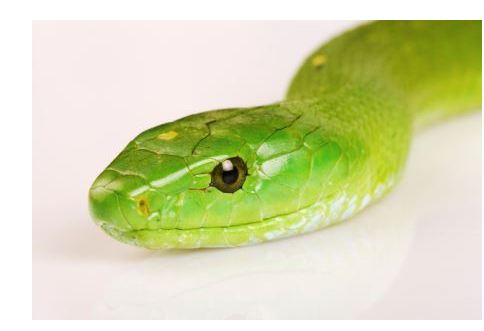
The Eastern Green Mamba (Dendroaspis angusticeps) is a venomous snake related to the highly dangerous Black Mamba. The Green Mamba is less aggressive and smaller than the Black Mamba, they average around 6 feet. The Green Mamba’s venom is also significantly less toxic, however a single bite could certainly be fatal to a human. Green mambas are highly arboreal (live in trees). They are generally found in south-eastern Africa. Like their name, Green Mambas are a lovely grass green color, but yellow when born. (WWW. hibiscuscoastseconds.co.za)